AK Ramanujan, the Kannada writer, once described his identity as the hyphen in “Indian-American”. Taking this idea forward, we can think of how we—multi-lingual speakers across the Indian terrain—are already connected people. This hyphen takes many shapes and forms in literature, in languages and in translation across India and beyond. We wish to acknowledge the existence of this junction and celebrate it through translation.
The literary treasures of India are vast and varied. Yet, like the grandmother searching under a streetlamp for a needle she lost at home—simply because there is light—we tend to focus only on what is visible. Indian literature showcased in mega events represents just a fraction of its richness, while much of it remains in darkness.
Within this larger endeavour, we believe in starting a conversation with our readers through this bi-monthly newsletter. The pieces in this newsletter will traverse various narrative forms, linguistic terrains, characters, ideas—reencountering the world we already know. Within each newsletter, you will get to enter different worlds, different time periods, different ways of thinking and different ways of telling.
With that, we hope you enjoy Hyphen’s first newsletter!
Mother Tongues
Do you remember your first word? Or even the first one you heard? Chances are, you don’t. All that remains are the stories your family tells—who you shouted for first, how everyone laughed, and the little chaos your tiny voice caused.
Language sneaks up on us. At first, we’re just copying sounds: a laugh here, a word there. Then suddenly, those sounds start to mean something. We’re pointing, asking, naming, understanding. Before you know it, the syllables you struggled to pronounce are helping you joke, argue, fall in love, or even betray someone—all with the same tiny sounds you absorbed without noticing.
Language isn’t just something you learn. It’s something that grows inside you. And it’s always a little magical.
Have you ever wondered who made up the first words? How were nouns, verbs and adjectives born? Who put exclamations? How did they figure out how tone changed meaning?
How about tracing it back?
If you are from the south of India and speak one of its languages, here’s a little surprise. All south Indian languages – the ‘Dravidian language family’– might just have originated in Ancient Elam, in present-day western Iran!
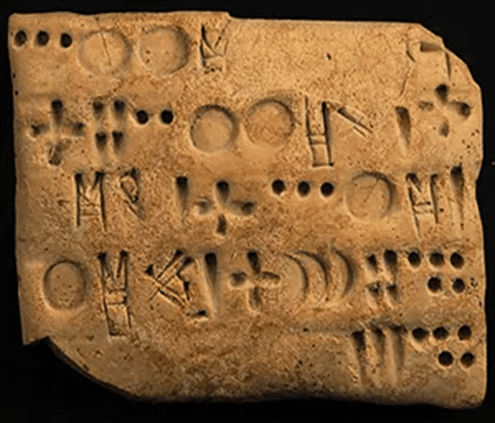
A seal excavated in Susa, present-day Iran with proto-Elamite inscriptions
Photograph: Courtesy History Today
Mountain Tongues
For the longest time, people believed that the Dravidian languages either originated in the Deccan region of the Indian subcontinent or in the Indus valley civilization. In the late 1900s, slightly different theories began to emerge. David McAlpin, an American linguist, suggested that Dravidian languages actually have an even older history; one that takes us to the Zagros mountains in ancient Elam. In the Zagros mountains in Elam, there was a community of hunter-gatherers that spoke what we now call Proto-Zagrosian. ( ‘Proto’ that keeps popping up just means that it was an older, simpler form of a language that later developed). These hunter-gatherers from Elam slowly traveled across central Asia and entered the Indian subcontinent more than 10,000 years ago.
But by the time these Iranian hunter gatherers came to India, the inhabitants of southern India (Ancestral South Indians) had already migrated to the subcontinent and were living and speaking their own language(s) here already. This means that when they carried their language- Proto-Zargosian- into the subcontinent, over years of transformation, cultural intermingling and mixing with existing phonic/linguistic systems used by the Ancestral South Indians, the Dravidian languages we speak and listen to now came into existence.
Therefore, it is from Proto-Zagrosian that centuries later, we have gotten Malayalam, Tamil, Telugu, Kannada, Konkani, Tulu and a host of other tribal languages such as Gondi, Kui, Koya and Nakkal. Isn’t that fascinating? Not to mention unexpected?
Brother Tongues?
But you might ask, how can I believe you when I know nothing about this language? How did this Proto-Zagrosian even sound? And you’re not wrong. Genetic evidence of migrations might be a good clue about languages traveling but not necessarily about them being similar right?
But since it has been harder to find written things in Proto-Zagrosian, we do something a little more indirect. It is like this: two brothers are separated at birth and their mother dies. Now since you cannot see if they look like their mother, you see if they look like each other and try to figure out if they have the same mother. So if Proto-Dravidian is one lost brother, then Proto-Elamite, another language that emerged from Proto-Zagrosian, is the other lost brother. While not all of Proto-Elamite has been deciphered, linguists have realised that a lot of words are in fact very similar between the two. Like ‘ur’ or ‘uru’ that is a word in multiple south Indian languages to mean a place/village/town, is the same in Elamite. And ‘ni’, the word for ‘your’, is also the same in Elamite!
Not just that, the very construction of most Dravidian languages is similar to the construction of Proto-Elamite. Let me explain. If you notice, when you are speaking most south Indian languages, there is a verb that is followed by a tense suffix; that is, an action followed by a little tail, let’s say, that tells you when the action was performed. Like ‘I am reading’ in Tamil is ‘Naa padikkaren’ where the ‘padi’ is the action, ‘kk’ is the sandhi (the connector) and ‘kiren’ is the tense marker, the part that tells you that the reading is happening now. In Telugu too you would say “Nenu chaduvuthunnanu” wherein the “chaduvu” is the action and the “thunnanu” is the suffix of ‘now’. As opposed to this, in a language like Hindi, you would say ‘Mein kitaab padh rahi hoon’ wherein the ‘padh’ is the action and is a separate word from the ‘rahi hoon’ which carries the tense. So this arrangement of actions and tenses and people and objects can also tell us of the similarities between two languages.
What Now?
Now these are a few examples, but you have to understand that this theory (that they call the Elamo-Dravidian theory by the way) is one that everybody is still fighting about: some say it is very likely and some say it is too far-fetched. What we take pride in and call ‘our culture’; might not be entirely homegrown. It is good to pause and think of how languages change, translate and grow all the time.
Enjoy this newsletter?
Get it delivered to your inbox. Join our growing community of readers.
Get the latest stories, insights, and perspectives delivered straight to your inbox.
Join our growing community of readers